I am not one who would argue for Calvinism or Armenianism on predestination. I find that we are all totally inept to fully understand the topic of the sovereignty and the grace of God put together. I was listening to Dick Lucas on Rev 3:14-22 this morning where he quoted a commentator* who said, “We got to find room for divine sovereignty and human responsibility and no theologian who has ever lived is able to resolve how to bring those together theoretically.”
What do you think? No one is able to resolve it? I kind of reconcile it with the fact that we have no way to save ourselves, and even if we can make the decision to believe in Him and so be saved, it is only made possible by the grace of a sovereign God. In a sense, yes, we will not be saved if we do not make the decision to believe in Him but we cannot make the decision in the first place if not for the grace of God. This God is both sovereign and gracious, and we cannot speak of his sovereignty and grace separately.
How would you reconcile it best you could?
pearlie
* He did not say (or I did not hear) who the commentator was. I could not google it either.

Showing posts with label mp3. Show all posts
Showing posts with label mp3. Show all posts
Friday, February 05, 2010

Tuesday, January 26, 2010
First last, last first, last first, first last
I was listening to the Gospel of Matthew this morning on the way to work and this passage struck me.
Matthew 19:30-20:16
30But many who are first will be last, and many who are last will be first.
1"For the kingdom of heaven is like a landowner who went out early in the morning to hire men to work in his vineyard. 2He agreed to pay them a denarius for the day and sent them into his vineyard.
3"About the third hour he went out and saw others standing in the marketplace doing nothing. 4He told them, 'You also go and work in my vineyard, and I will pay you whatever is right.' 5So they went.
"He went out again about the sixth hour and the ninth hour and did the same thing. 6About the eleventh hour he went out and found still others standing around. He asked them, 'Why have you been standing here all day long doing nothing?'
7" 'Because no one has hired us,' they answered.
"He said to them, 'You also go and work in my vineyard.'
8"When evening came, the owner of the vineyard said to his foreman, 'Call the workers and pay them their wages, beginning with the last ones hired and going on to the first.'
9"The workers who were hired about the eleventh hour came and each received a denarius. 10So when those came who were hired first, they expected to receive more. But each one of them also received a denarius. 11When they received it, they began to grumble against the landowner. 12'These men who were hired last worked only one hour,' they said, 'and you have made them equal to us who have borne the burden of the work and the heat of the day.'
13"But he answered one of them, 'Friend, I am not being unfair to you. Didn't you agree to work for a denarius? 14Take your pay and go. I want to give the man who was hired last the same as I gave you. 15Don't I have the right to do what I want with my own money? Or are you envious because I am generous?'
16"So the last will be first, and the first will be last."
I am an HR practitioner and every time I read this passage, I can really hear the workers who complained to Jesus, because I do hear it every now and then, and actually I just had an earful of it yesterday, but remember, this is a parable and like any parable, it gave the intended audience at that time, one lesson they need to learn, and the lesson here is pretty clear - in fact, the parable itself is sandwiched by it in a mirror image.
"But many who are first will be last, and many who are last will be first...So the last will be first, and the first will be last."
It is a hard thing to accept. Sometimes, I try this at work but I know it doesn't work. We talk about fairness, we expect equity, internal and external, and yet there is a truth here in what Jesus teaches: "Don't I have the right to do what I want with my own money? Or are you envious because I am generous?"
We feel the unfairness sometimes at how the cards are dealt in our lives compared to the others, but I know that when one thinks only about themselves, then there will be unfairness but when we think for the others, there will be rejoicing.
A hard lesson but a needed one, and dead important: First last, last first, last first, first last.
pearlie
* I wonder what this is technically called? Do you know?
Matthew 19:30-20:16
30But many who are first will be last, and many who are last will be first.
1"For the kingdom of heaven is like a landowner who went out early in the morning to hire men to work in his vineyard. 2He agreed to pay them a denarius for the day and sent them into his vineyard.
3"About the third hour he went out and saw others standing in the marketplace doing nothing. 4He told them, 'You also go and work in my vineyard, and I will pay you whatever is right.' 5So they went.
"He went out again about the sixth hour and the ninth hour and did the same thing. 6About the eleventh hour he went out and found still others standing around. He asked them, 'Why have you been standing here all day long doing nothing?'
7" 'Because no one has hired us,' they answered.
"He said to them, 'You also go and work in my vineyard.'
8"When evening came, the owner of the vineyard said to his foreman, 'Call the workers and pay them their wages, beginning with the last ones hired and going on to the first.'
9"The workers who were hired about the eleventh hour came and each received a denarius. 10So when those came who were hired first, they expected to receive more. But each one of them also received a denarius. 11When they received it, they began to grumble against the landowner. 12'These men who were hired last worked only one hour,' they said, 'and you have made them equal to us who have borne the burden of the work and the heat of the day.'
13"But he answered one of them, 'Friend, I am not being unfair to you. Didn't you agree to work for a denarius? 14Take your pay and go. I want to give the man who was hired last the same as I gave you. 15Don't I have the right to do what I want with my own money? Or are you envious because I am generous?'
16"So the last will be first, and the first will be last."
I am an HR practitioner and every time I read this passage, I can really hear the workers who complained to Jesus, because I do hear it every now and then, and actually I just had an earful of it yesterday, but remember, this is a parable and like any parable, it gave the intended audience at that time, one lesson they need to learn, and the lesson here is pretty clear - in fact, the parable itself is sandwiched by it in a mirror image.
"But many who are first will be last, and many who are last will be first...So the last will be first, and the first will be last."
It is a hard thing to accept. Sometimes, I try this at work but I know it doesn't work. We talk about fairness, we expect equity, internal and external, and yet there is a truth here in what Jesus teaches: "Don't I have the right to do what I want with my own money? Or are you envious because I am generous?"
We feel the unfairness sometimes at how the cards are dealt in our lives compared to the others, but I know that when one thinks only about themselves, then there will be unfairness but when we think for the others, there will be rejoicing.
A hard lesson but a needed one, and dead important: First last, last first, last first, first last.
I am taught that when anything is repeated in Scriptures, it is very important. More so here, being repeated in parallel and mirrored in three parts.*
pearlie
* I wonder what this is technically called? Do you know?
Monday, January 04, 2010
Four Essentials to Finishing Well

I listened to Jerry Bridges' sermon on Four Essentials to Finishing Well this morning on my way back to work for the New Year - it was excellent.
The four essentials in short are:
1. Daily time of focused personal communion with God
2. Daily appropriation of the gospel
3. Daily commit yourself to God as a living sacrifice
4. A firm belief in the sovereignty and love of God
What strike me most at this point of time is the first one. I am not a person who finds schedules and timetables at all friendly - I have sort of conceded to a flexible time of as and when I do it. And true enough, like what Bridges pointed out, there will be a high chance of drifting as a result, which is exactly what happened to me over the recent year-end break - I just rotted away at home. It was only when I got back into my obligations of the usual daily routine that I got back into a more focussed time with God. This would mean that I need to do away with that view I have on flexibility when it comes to my personal communion with God and be more disciplined to keep a time. But I do not think I can change right away. I would still shy away from a fixed routine given a choice but I must work at it to at least keep a conscious time everyday to spend time reading Scripture with God and listening to him speak to me.
pearlie
Photo from DesiringGod.org
Monday, March 16, 2009
Three Sermons
Been listening to several sermons today:
The ABC of Godly living in an unholy world
by David Monro
Trials of Life
by Stephen Um
Trials
by D.A. Carson
pearlie
The ABC of Godly living in an unholy world
by David Monro
Trials of Life
by Stephen Um
Trials
by D.A. Carson
pearlie
Tuesday, February 24, 2009
The joy of the Lord is your strength
Melissa sent me an mp3 lecture on "Liturgy, Worship and the Ordering of Affections" by Gordon T. Smith. I like his tone of lecture as well as the form and style of language but more than that, he spoke about something that I find close to my heart at the moment - the joy of doing anything at all.
He said joy is the tonality of Christianity. He quoted Alexander Schmemman, "I think God will forgive everthing except lack of joy." He believes that, "Spiritual formation must necessarily include the ordering of the deep loves, desires and longings of the Christian."
I find lately that I am been in circumstances where negative emotions were rife wherever I was. There is such a great need for us to order our emotions and desires to serve the Lord in whatever we do -- be it in the church or in our vocation, in the study of Scripture or the practice of the disciplines -- to do it all with joy in the Lord.
Our faces and our eyes mirror our state of emotion in all that we do. Are our faces mournful, are our eyes dull? Or are they brilliant, shining with joy in the Lord?
No wonder Nehemiah said, "Do not be grieved, for the joy of the Lord is your strength."
pearlie
He said joy is the tonality of Christianity. He quoted Alexander Schmemman, "I think God will forgive everthing except lack of joy." He believes that, "Spiritual formation must necessarily include the ordering of the deep loves, desires and longings of the Christian."
I find lately that I am been in circumstances where negative emotions were rife wherever I was. There is such a great need for us to order our emotions and desires to serve the Lord in whatever we do -- be it in the church or in our vocation, in the study of Scripture or the practice of the disciplines -- to do it all with joy in the Lord.
Our faces and our eyes mirror our state of emotion in all that we do. Are our faces mournful, are our eyes dull? Or are they brilliant, shining with joy in the Lord?
No wonder Nehemiah said, "Do not be grieved, for the joy of the Lord is your strength."
pearlie
Tuesday, February 10, 2009
Paul Washer on Prayer
I was at Faith by Hearing and downloaded Paul Washer's sermon on Prayer. According to Todd from Faith by Hearing, "Paul Washer’s message on prayer is one of the best, and most convicting and re-orienting, that I’ve ever heard."
I have been searching about what I deem the mystery of prayer for awhile now and I looked forward to hearing what Washer has to say.
Todd further commented that, "One always comes to the question, 'Why did Jesus pray if he was God?' The answer we usually get is that Jesus needed to pray because he needed to depend upon God in his humanity, and because he had so much to accomplish. Rubbish, according to Washer. Jesus prayed because he loved to be in communion with God the Father. Need didn’t drive him to prayer, love did. We are commanded to the same love, 'Love the Lord your God with all your heart…' "
This was enough to get me interested.
But upon hearing Washer, I am not so sure now - I have many questions, as usual ... and I am not sure if I agree with everything he said ... or am I just being unwilling to change? I need to listen to it again and re-evaluate my thoughts.
pearlie
I have been searching about what I deem the mystery of prayer for awhile now and I looked forward to hearing what Washer has to say.
Todd further commented that, "One always comes to the question, 'Why did Jesus pray if he was God?' The answer we usually get is that Jesus needed to pray because he needed to depend upon God in his humanity, and because he had so much to accomplish. Rubbish, according to Washer. Jesus prayed because he loved to be in communion with God the Father. Need didn’t drive him to prayer, love did. We are commanded to the same love, 'Love the Lord your God with all your heart…' "
This was enough to get me interested.
But upon hearing Washer, I am not so sure now - I have many questions, as usual ... and I am not sure if I agree with everything he said ... or am I just being unwilling to change? I need to listen to it again and re-evaluate my thoughts.
pearlie
Tuesday, August 26, 2008
I don't believe in coincidences
I am pretty stressed out lately, to the point that I get panicky at the slightest feel of loss of control. On my way to work this morning, I was rummaging through the new selection of mp3 sermons I had just downloaded. I thought to myself, "Wouldn’t it be nice to listen to Dick Lucas on Philippians?"
Scrolling down the mp3 list, I settled on this series of four sermons by Dick Lucas entitled “All I Want”, and as you would have it, they were his expository Tuesday Lunch sermons on Philippians 3.
The Epistle to the Philippians is my favourite Pauline epistle.
And believe you me, Dick Lucas seem to have that calming effect on me – his tone, his faithful handling of Scripture, his dry wit and his sometimes no nonsense word of exhortation.
My favourite Pauline epistle and my favourite expositor-preacher, combine these two and it should settle me down.
I don't believe in coincidences. God hears our every thought.
pearlie
Scrolling down the mp3 list, I settled on this series of four sermons by Dick Lucas entitled “All I Want”, and as you would have it, they were his expository Tuesday Lunch sermons on Philippians 3.
The Epistle to the Philippians is my favourite Pauline epistle.
And believe you me, Dick Lucas seem to have that calming effect on me – his tone, his faithful handling of Scripture, his dry wit and his sometimes no nonsense word of exhortation.
My favourite Pauline epistle and my favourite expositor-preacher, combine these two and it should settle me down.
I don't believe in coincidences. God hears our every thought.
pearlie
Friday, June 06, 2008
The Unanswered Prayers and the Answered Prayer
Melissa once asked if I am “into Englishmen and stiff, upper-lip British English”.
Ah, I am not sure about the first one, since I do not really know any Englishman but she is absolutely right on the second!
Anyway, that is beside the point. I have uploaded several of Dick Lucas’ talks into my cellphone and I had let it run as I commute to and fro work. I happened to hear his session on 1 Kings 18 on The Unanswered Prayers and the Answered Prayer.
Talk about my endless study and thinking on the subject of prayer, this session seriously hit the nail in the head for me – it is about the most realistic thing I have heard about prayer.
It won’t do justice to have it summarised here. You have to listen it for yourself – the session is just brilliant. Get the mp3 here.
pearlie
Ah, I am not sure about the first one, since I do not really know any Englishman but she is absolutely right on the second!
Anyway, that is beside the point. I have uploaded several of Dick Lucas’ talks into my cellphone and I had let it run as I commute to and fro work. I happened to hear his session on 1 Kings 18 on The Unanswered Prayers and the Answered Prayer.
Talk about my endless study and thinking on the subject of prayer, this session seriously hit the nail in the head for me – it is about the most realistic thing I have heard about prayer.
It won’t do justice to have it summarised here. You have to listen it for yourself – the session is just brilliant. Get the mp3 here.
pearlie
Thursday, May 29, 2008
An excellent exposition on Ps 119

I have found Dick Lucas' expository sessions so well done and enormously beneficial. In my efforts to understand the bible and put God's commands into practice, I find his sessions a joy to listen to, with many things to learn.
I was listening in these couple of days to his exposition on Psalm 119.
He reminded us that there are those who paints a picture of a Christian life or standards for the church that would be too ideal and unreal. What we can gain from Psalm 119 though is a realistic model of Christian spirituality for every age and every person - not something that is too ideal or unrealistic to be followed.
He gave a clue or key to the reading of Psalm 119. It is one, unlike most psalms, that has no logical flow, no argument that leads to a conclusion, no melodic line, and it even ends with a sad anti-climax. Refering to Alexan Alexander, he said that Psalm 119 is intended as a "storehouse of material for pious meditation rather than a discourse of continuous perusal".
The psalm is rich in covenantal language that shows us what a close relationship the psalmist has with the Almighty God. I also realised that the psalm is full of pain - I never saw that. The psalmist was very open about his emotions on the dismal condition of himself, on Israel and on humankind.
There are many changes required in me to attune my life to God's standard. We need a standard to level up our lives on, and that standard is nothing but the Word of God. No sooner had I wanted to include "and our Lord and Saviour" to the standard, I realised in amazement that He is the Word.
Dick also said that in fact, only a pulpit and a table is needed in our churches.
A pulpit that only preaches the Word; a table that only serves bread and wine, and only functions as how Christ has asked us to remember. If the pulpit and the table is being used otherwise, we have strayed from the standard and they no longer represent the Gospel of Christ.
I need to be reading the psalm again today.
pearlie
Friday, May 02, 2008
Introduction to the Gospel of John
We had our first bible study session on the Gospel of John today, and I must say it was fruitful. There were just the eight of us - about 10% of the size of the congregation - which I was told is the norm.
A Short Introduction
We discussed the different genres of the New Testament:
1. Gospels - Matthew, Mark, Luke, John
2. Historical - Acts of the Apostles
3. Epistles - letters of Paul, Peter, etc.
4. Apocalypse - Revelations
A Summary of the Four Gospels

Click to view
The Gospel of John
This Gospel is among the most debated books in the bible - particularly on its authorship, date of writing and time length of writing.
1. Authorship - generally believed to be John, the apostle, the brother of James and the son of Zebedee
2. Date - c. A.D.66-98
3. Structure - its basic structure seems fairly simple until you start to hink about it; there is complexity wrapped in simplicity is the reason why scores of studies on John's structure have been published in the last two or three decades. (D.A. Carson, The Gospel According to John, PNTC, 1991, p.103)
4. Style - written in simple Greek, distinctive dialogues, discussions and long discourses, features the way people misunderstand Jesus (e.g. Nicodemus and "being born again", double meanings (e.g. Jesus being lifted up), dualism (e.g. light and darkness).
5. In the Synoptics but not in John - Jesus' baptism, temptation, exorcisms, pithy parables, much reference to the kingdom of God, the Transfiguration, institution of the Lord's Supper.
6. In John but not in the Synoptics - turning water into wine, raising of Lazarus, the "I am" sayings, explicit affirmations of Jesus' pre-existence, the piercing of Jesus' side.
Questions Raised Up
1. I brought up the fact that the epistles were written before the Gospels. Like how I was surprised when I first found that out, the group was too and asked multiple questions about when what was written, and when Paul was converted. I just found a Timeline of Christianity in Wikipedia, of which I will definitely highlight next week. It lists out a lot of information and you would need to wade through it to find what you need. However, it did not indicate the year Paul was converted. I found out somewhere that it the year is circa A.D. 36. Close?
2. I also highlighted that the Gospels in general are not written chronologically. The evangelists wrote the Gospels for their set purposes and structured them in a way to achieve that. Someone asked which Gospel then would be the most chronological one. I promised her I will l find that out but now that I think about it, how does one define "most chronological" - it just is or it is not. I found a very interesting diagram here. It is labelled "sample" all over though - I wonder which area of that diagram is a sample, and what is it a sample of?
Finally, I also found a good summary of the books of the New Testament here, referenced to Metzger's The Canon of the New Testament. The internet is such a good place to find information, but only if we know what's good for us. Anyway, I have started a repository of bible resources for studying the Gospel of John here. Do let me know if you have some good resources I can include or link to.
Finally, to draw the study of the day to a close, I made it a point to appropriate what we learn into practicalities. I referred the group to Carson's session on "What is the Gospel?". His main concern is the danger of reducing the Gospel to something assumed. If the pastors and leaders of the church assumes the Gospel and proceed to be concerned with everything else other than the Gospel -- be it evangelism, the poor, happiness, prosperity, doctrinal debates, dangers on the left, dangers on the right, and what have you -- we will train a new generation to downplay the gospel and focus zeal on the periphery. Though some of these are not only important but are commandments of God, they are not the Gospel.
It is worth listening to. The mp3 is found here and the transcript, if you would rather just read it, is found here.
We begin with John's Prologue next week! But first we have homework ;)
pearlie
A Short Introduction
We discussed the different genres of the New Testament:
1. Gospels - Matthew, Mark, Luke, John
2. Historical - Acts of the Apostles
3. Epistles - letters of Paul, Peter, etc.
4. Apocalypse - Revelations
A Summary of the Four Gospels
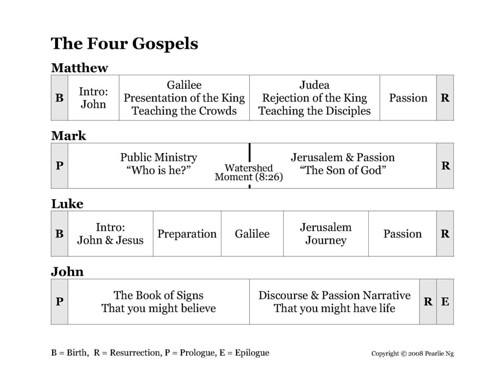
Click to view
The Gospel of John
This Gospel is among the most debated books in the bible - particularly on its authorship, date of writing and time length of writing.
1. Authorship - generally believed to be John, the apostle, the brother of James and the son of Zebedee
2. Date - c. A.D.66-98
3. Structure - its basic structure seems fairly simple until you start to hink about it; there is complexity wrapped in simplicity is the reason why scores of studies on John's structure have been published in the last two or three decades. (D.A. Carson, The Gospel According to John, PNTC, 1991, p.103)
4. Style - written in simple Greek, distinctive dialogues, discussions and long discourses, features the way people misunderstand Jesus (e.g. Nicodemus and "being born again", double meanings (e.g. Jesus being lifted up), dualism (e.g. light and darkness).
5. In the Synoptics but not in John - Jesus' baptism, temptation, exorcisms, pithy parables, much reference to the kingdom of God, the Transfiguration, institution of the Lord's Supper.
6. In John but not in the Synoptics - turning water into wine, raising of Lazarus, the "I am" sayings, explicit affirmations of Jesus' pre-existence, the piercing of Jesus' side.
Questions Raised Up
1. I brought up the fact that the epistles were written before the Gospels. Like how I was surprised when I first found that out, the group was too and asked multiple questions about when what was written, and when Paul was converted. I just found a Timeline of Christianity in Wikipedia, of which I will definitely highlight next week. It lists out a lot of information and you would need to wade through it to find what you need. However, it did not indicate the year Paul was converted. I found out somewhere that it the year is circa A.D. 36. Close?
2. I also highlighted that the Gospels in general are not written chronologically. The evangelists wrote the Gospels for their set purposes and structured them in a way to achieve that. Someone asked which Gospel then would be the most chronological one. I promised her I will l find that out but now that I think about it, how does one define "most chronological" - it just is or it is not. I found a very interesting diagram here. It is labelled "sample" all over though - I wonder which area of that diagram is a sample, and what is it a sample of?

Finally, I also found a good summary of the books of the New Testament here, referenced to Metzger's The Canon of the New Testament. The internet is such a good place to find information, but only if we know what's good for us. Anyway, I have started a repository of bible resources for studying the Gospel of John here. Do let me know if you have some good resources I can include or link to.
Finally, to draw the study of the day to a close, I made it a point to appropriate what we learn into practicalities. I referred the group to Carson's session on "What is the Gospel?". His main concern is the danger of reducing the Gospel to something assumed. If the pastors and leaders of the church assumes the Gospel and proceed to be concerned with everything else other than the Gospel -- be it evangelism, the poor, happiness, prosperity, doctrinal debates, dangers on the left, dangers on the right, and what have you -- we will train a new generation to downplay the gospel and focus zeal on the periphery. Though some of these are not only important but are commandments of God, they are not the Gospel.
It is worth listening to. The mp3 is found here and the transcript, if you would rather just read it, is found here.
We begin with John's Prologue next week! But first we have homework ;)
pearlie
Thursday, April 17, 2008
John Newton (1725-1807)

I am back to feasting on mp3 sermons while I commute daily to work and back. I have perfectly timed the chunks into 3 sections to fit my requirements and as such I get to complete a sermon a day. I have finished D.A. Carson's expository sessions on Jeremiah today and have prepped up Dick Lucas's sessions on Psalms for the next few days. I have not heard or read him before, and so I'll have to see how good he is.
From Carson's session on Jeremiah today, he brought up John Newton and one of his sayings. I checked him out and realised he is the very John Newton who wrote the "Amazing Grace". Carson's quoted this:
I am not what I ought to be.What beautiful words, and smack right on the point. I did a search and found more - he certainly has a way with words and his thoughts are simply awe-inspiring.
I am not what I want to be.
I am not what I hope to be.
But still,
I am not what I used to be.
And by the grace of God,
I am what I am.
Here's one that is surely close to my heart considering what I have been thinking about lately:
If ever I reach heaven I expect to find three wonders there: first, to meet some I had not thought to see there; second, to miss some I had expected to see there; and third - the greatest wonder of all - to find myself there.I agree wholeheartedly with him on this one, though I would still talk about Arminians and Calvinists only to try to find a bridge between the two, as hard as I may:
I endeavour to keep all Shibboleths, and forms and terms of distinction out of sight, as we keep knives and razors out of the way of children; and if my hearers had not some other means of information, I think they would not know from me that there are such creatures as Arminians and Calvinists in the world. But we [would] talk a good deal about Christ.pearlie
Picture from NNDB
Monday, March 17, 2008
Holy MondayBecause of the blood of the Lamb
I was having problems with getting the mp3 player to work properly in my car but I finally got it settled and in good timing too. I did not have anything planned for the Holy Week. Without much of a thought, I proceeded on with the rest of Carson’s mp3s on Revelations 12. As it turns out, the message was a resounding one:
The Evil One has been defeated. He has been thrown down and he is full of fury. He knows his time is short and therefore he is taking the opportunity to pull down as many people as possible. Over the centuries, ever since Jesus' crucifixion on the cross and his glorious resurrection, the Evil One has been actively doing that. But the redeemed in Christ has been defeating him and will continue to overcome him. This is because of three things (Rev 12:11).
Revelation 12:11
And they overcame him because of the blood of the Lamb and because of the word of their testimony, and they did not love their life even when faced with death.
It is first and foremost, the blood of the Lamb, then it is the word of our testimony and denying of self because of the cross. This is a great challenge for us who are covered by the blood of the Lamb to hold on to our duty to testify for His namesake and present ourselves as sacrifices, to deny ourselves for the sake of Christ.
Revelation 12:12
For this reason, rejoice, O heavens and you who dwell in them. Woe to the earth and the sea, because the devil has come down to you, having great wrath, knowing that he has only a short time.
pearlie
The Evil One has been defeated. He has been thrown down and he is full of fury. He knows his time is short and therefore he is taking the opportunity to pull down as many people as possible. Over the centuries, ever since Jesus' crucifixion on the cross and his glorious resurrection, the Evil One has been actively doing that. But the redeemed in Christ has been defeating him and will continue to overcome him. This is because of three things (Rev 12:11).
Revelation 12:11
And they overcame him because of the blood of the Lamb and because of the word of their testimony, and they did not love their life even when faced with death.
It is first and foremost, the blood of the Lamb, then it is the word of our testimony and denying of self because of the cross. This is a great challenge for us who are covered by the blood of the Lamb to hold on to our duty to testify for His namesake and present ourselves as sacrifices, to deny ourselves for the sake of Christ.
Revelation 12:12
For this reason, rejoice, O heavens and you who dwell in them. Woe to the earth and the sea, because the devil has come down to you, having great wrath, knowing that he has only a short time.
pearlie
Tuesday, February 19, 2008
In chunks
As I was saying, I am currently listening to sermons and bible lessons in mp3s, in chunks as I zip my way here and there and everywhere in my old beat-up car. It is slow, I know and I also end up listening to certain portions several times over (long story but I have to break up the mp3s into chunks so that I don't have to listen to them from the beginning everytime I start my car). I find that I am learning so much with the spare time I have. It is so much better. Rather than to have my mind wander off aimlessly as I manoeuvre the roads or to fill it up with trash listening to the radio, I can now learn, think, discover and be amazed with God, my Strength and my Redeemer. I have grown tired with the limited selection of CDs I have anyway.
I have just started on Carson's teaching sessions on Revelations. I was on his first session on Rev 4 yesterday and Rev 5 today. I have just finished the first chunk and looking forward for more chunks later when I drive home after work.
My dad, who is a lay-preacher was telling me that based on his experience, he finds that what preachers usually repeat are illustrations and stories. That to me, is not very good a practice because illustrations and stories are usually the only thing the people will remember, if they remember anything at all, and therefore, a good preacher has to have a good variety of them, so that he does not repeat them too often.
But, because of the proliferation of sermons in mp3s, I have found that Carson, who is an excellent speaker by the way, uses similar illustrations, in different settings, in different sermons, in different topics. And it works for him, the illustrations serve for him as good analogies almost all the time.
In his Rev 5 session, in order to explain the distinctive use of the apocalypse genre, he used the examples of limericks: where he says that only in the English language, are limericks possible (Really? Is that true?) He used this limerick, apparently written to good-naturedly poke fun at Dr C.H. Dodd:
There was a professor called Dodd,
Whose name was exceedingly odd;
He spelled, if you please,
His name with three "D's,"
When one was sufficient for God.
I love it! I did a search - Carson also used this limerick in his speaking session on Justification by Faith. True but it works.
pearlie
I have just started on Carson's teaching sessions on Revelations. I was on his first session on Rev 4 yesterday and Rev 5 today. I have just finished the first chunk and looking forward for more chunks later when I drive home after work.
My dad, who is a lay-preacher was telling me that based on his experience, he finds that what preachers usually repeat are illustrations and stories. That to me, is not very good a practice because illustrations and stories are usually the only thing the people will remember, if they remember anything at all, and therefore, a good preacher has to have a good variety of them, so that he does not repeat them too often.
But, because of the proliferation of sermons in mp3s, I have found that Carson, who is an excellent speaker by the way, uses similar illustrations, in different settings, in different sermons, in different topics. And it works for him, the illustrations serve for him as good analogies almost all the time.
In his Rev 5 session, in order to explain the distinctive use of the apocalypse genre, he used the examples of limericks: where he says that only in the English language, are limericks possible (Really? Is that true?) He used this limerick, apparently written to good-naturedly poke fun at Dr C.H. Dodd:
There was a professor called Dodd,
Whose name was exceedingly odd;
He spelled, if you please,
His name with three "D's,"
When one was sufficient for God.
I love it! I did a search - Carson also used this limerick in his speaking session on Justification by Faith. True but it works.
pearlie
Wednesday, February 13, 2008
Two Sermons
I was listening to two of John Stott's sermons on mp3 today: "When God's People Pray" and "The Word of Life". I was told that he is an excellent preacher and he certainly is.
In "When God's People Pray", I have never heard very much of a good sermon on prayer until now. He brought out 4 points from Ephesians 2:18, "For through him we both have access to the Father by one Spirit." Prayer is first and foremost, access to the Father. That I feel is an excellent and more than that, a biblical definition of prayer; one I will be using from now on: access to the Father.
The four points are:
1. Access is to the Father
Prayers are directed to the Father, and thus they should be like a prayer of a child, simple. Stott says that our prayers sometimes can be too sophisticated, not simple enough. (How true! I tend to pray simple prayers in private but try to make them more sophisticated when in public. I see know how foolish that can be.)
2. Access is through the Son
Prayer should be performed in humility because it can only be done through the Son's sin bearing death. Let us not take that privilege for granted. Our utterances in prayer should be humble, not haughty or proud. (This reminds me of what I term as our "language of prayer". The next time we pray or hear a pray in church, try to take notice of the language we use, and conclude if it is a prayer that is humble and God-honouring or is it a prayer that begins every sentence with what sounds like a command: Lord, do this and Lord do that, even if it is a pleading prayer for the church or for others.)
3. Access is by the Spirit
Prayer is performed by the inspiration of the Holy Spirit. It is with intimacy, it is when the Spirit bear witness with our spirits that we are the children of God. He assures us of the lovingkindness of the Holy Father and the saving grace of our Saviour Jesus Christ. He takes our wayward undisciplined minds and focusses them upon God. He helps us to pray and lead us into the very presence of God.
4. Access is with all the people of God
When Paul says in Eph 2:18 that "we both have our access", he meant both Jews and Gentiles, in that we all have access to the Father as one community of prayer. When we pray, we must be reminded that we are praying as one universal body of Christ. When one prays, the prayer is among the many prayers of the people of God. So look not only on our own needs.
About "The Word of Life" sermon, what is interesting is that he brings out lessons we can learn from Doubting Thomas. What he says about our modern world is quite true - in that we look up on Thomas and commend him for doubting and for seeking for empirical proof in order to belief, because that is usually what we would seek for today. But Jesus rebuked him for that. The lesson to learn is this: it is more blessed to have not seen and yet believed. The words of the eyewitnesses of Christ, who are credible and reliable, are as good as empirical evidences.
Stott also has a way with words. He commented about Thomas being absent the first time when the disciples gathered when Jesus came amongst them. He talked about the "calculated risk taken by irregular churchgoers" and the "spiritual risk of spasmodic church attendance" as opposed to "spiritual blessings of disciplined regularity". Isn't that brilliant!
pearlie
In "When God's People Pray", I have never heard very much of a good sermon on prayer until now. He brought out 4 points from Ephesians 2:18, "For through him we both have access to the Father by one Spirit." Prayer is first and foremost, access to the Father. That I feel is an excellent and more than that, a biblical definition of prayer; one I will be using from now on: access to the Father.
The four points are:
1. Access is to the Father
Prayers are directed to the Father, and thus they should be like a prayer of a child, simple. Stott says that our prayers sometimes can be too sophisticated, not simple enough. (How true! I tend to pray simple prayers in private but try to make them more sophisticated when in public. I see know how foolish that can be.)
2. Access is through the Son
Prayer should be performed in humility because it can only be done through the Son's sin bearing death. Let us not take that privilege for granted. Our utterances in prayer should be humble, not haughty or proud. (This reminds me of what I term as our "language of prayer". The next time we pray or hear a pray in church, try to take notice of the language we use, and conclude if it is a prayer that is humble and God-honouring or is it a prayer that begins every sentence with what sounds like a command: Lord, do this and Lord do that, even if it is a pleading prayer for the church or for others.)
3. Access is by the Spirit
Prayer is performed by the inspiration of the Holy Spirit. It is with intimacy, it is when the Spirit bear witness with our spirits that we are the children of God. He assures us of the lovingkindness of the Holy Father and the saving grace of our Saviour Jesus Christ. He takes our wayward undisciplined minds and focusses them upon God. He helps us to pray and lead us into the very presence of God.
4. Access is with all the people of God
When Paul says in Eph 2:18 that "we both have our access", he meant both Jews and Gentiles, in that we all have access to the Father as one community of prayer. When we pray, we must be reminded that we are praying as one universal body of Christ. When one prays, the prayer is among the many prayers of the people of God. So look not only on our own needs.
About "The Word of Life" sermon, what is interesting is that he brings out lessons we can learn from Doubting Thomas. What he says about our modern world is quite true - in that we look up on Thomas and commend him for doubting and for seeking for empirical proof in order to belief, because that is usually what we would seek for today. But Jesus rebuked him for that. The lesson to learn is this: it is more blessed to have not seen and yet believed. The words of the eyewitnesses of Christ, who are credible and reliable, are as good as empirical evidences.
Stott also has a way with words. He commented about Thomas being absent the first time when the disciples gathered when Jesus came amongst them. He talked about the "calculated risk taken by irregular churchgoers" and the "spiritual risk of spasmodic church attendance" as opposed to "spiritual blessings of disciplined regularity". Isn't that brilliant!
pearlie
Tuesday, January 29, 2008
Sermons on the go
With the recent discovery of the wealth of good mp3 sermons found online, I should now be able to spend my time commuting in busy Kuala Lumpur in a more worthwhile manner.
I have heard three so far. Ligon Duncan's "How to Listen to a Bad Sermon", which I thought was just excellent. Gordon Wenham's "Praying the Psalms" was just as superb to bring us back to the practice of praying the psalms - he gives theological and practical reasons for praying and using not only praise psalms but also lament and penitential psalms in public worship.
Today, I listened to John Piper's "Marriage: God's Showcase of Covenant Keeping Grace". It was very refreshing to hear a great sermon preached on the subject of marriage. He has approached it in a manner I have never ever encountered any preacher doing so. He based his sermon on Colossians 2:13-15, 3:12-19.
Colossians 2:13-15, 3:12-19
13 And you, who were dead in your trespasses and the uncircumcision of your flesh, God made alive together with him, having forgiven us all our trespasses, 14 by canceling the record of debt that stood against us with its legal demands. This he set aside, nailing it to the cross. 15 He disarmed the rulers and authorities and put them to open shame, by triumphing over them in him ...
12 Put on then, as God's chosen ones, holy and beloved, compassion, kindness, humility, meekness, and patience, 13 bearing with one another and, if one has a complaint against another, forgiving each other; as the Lord has forgiven you, so you also must forgive. 14 And above all these put on love, which binds everything together in perfect harmony. 15 And let the peace of Christ rule in your hearts, to which indeed you were called in one body. And be thankful. 16 Let the word of Christ dwell in you richly, teaching and admonishing one another in all wisdom, singing psalms and hymns and spiritual songs, with thankfulness in your hearts to God. 17 And whatever you do, in word or deed, do everything in the name of the Lord Jesus, giving thanks to God the Father through him. 18 Wives, submit to your husbands, as is fitting in the Lord. 19 Husbands, love your wives, and do not be harsh with them.
Piper sees marriage as the doing of God and the display of God. It is God who is the subject, the head, the leader, the initiator, the creator; not the husband, not the wife. In this sermon (there are several parts to the series found here in the Desiring God website) he sees marriage, as taught by Jesus and Paul, the model of Christ and the Church, and it needs a solid basis in grace.
In short, in a Christian marriage relationship, we should not so much look into the spouse in his or her weakness, which will surely show after years of being naked in body, soul and spirit together. Instead, we are to look at each other as forgiven and justified by faith in Christ. He or she is just as much forgiven as you are. So look at him how Christ looks at him; look at her how Christ looks at her - justified and forgiven - and receive each other in peace and love.
I find this message so utterly refreshing.
pearlie
I have heard three so far. Ligon Duncan's "How to Listen to a Bad Sermon", which I thought was just excellent. Gordon Wenham's "Praying the Psalms" was just as superb to bring us back to the practice of praying the psalms - he gives theological and practical reasons for praying and using not only praise psalms but also lament and penitential psalms in public worship.
Today, I listened to John Piper's "Marriage: God's Showcase of Covenant Keeping Grace". It was very refreshing to hear a great sermon preached on the subject of marriage. He has approached it in a manner I have never ever encountered any preacher doing so. He based his sermon on Colossians 2:13-15, 3:12-19.
Colossians 2:13-15, 3:12-19
13 And you, who were dead in your trespasses and the uncircumcision of your flesh, God made alive together with him, having forgiven us all our trespasses, 14 by canceling the record of debt that stood against us with its legal demands. This he set aside, nailing it to the cross. 15 He disarmed the rulers and authorities and put them to open shame, by triumphing over them in him ...
12 Put on then, as God's chosen ones, holy and beloved, compassion, kindness, humility, meekness, and patience, 13 bearing with one another and, if one has a complaint against another, forgiving each other; as the Lord has forgiven you, so you also must forgive. 14 And above all these put on love, which binds everything together in perfect harmony. 15 And let the peace of Christ rule in your hearts, to which indeed you were called in one body. And be thankful. 16 Let the word of Christ dwell in you richly, teaching and admonishing one another in all wisdom, singing psalms and hymns and spiritual songs, with thankfulness in your hearts to God. 17 And whatever you do, in word or deed, do everything in the name of the Lord Jesus, giving thanks to God the Father through him. 18 Wives, submit to your husbands, as is fitting in the Lord. 19 Husbands, love your wives, and do not be harsh with them.
Piper sees marriage as the doing of God and the display of God. It is God who is the subject, the head, the leader, the initiator, the creator; not the husband, not the wife. In this sermon (there are several parts to the series found here in the Desiring God website) he sees marriage, as taught by Jesus and Paul, the model of Christ and the Church, and it needs a solid basis in grace.
In short, in a Christian marriage relationship, we should not so much look into the spouse in his or her weakness, which will surely show after years of being naked in body, soul and spirit together. Instead, we are to look at each other as forgiven and justified by faith in Christ. He or she is just as much forgiven as you are. So look at him how Christ looks at him; look at her how Christ looks at her - justified and forgiven - and receive each other in peace and love.
I find this message so utterly refreshing.
pearlie
Subscribe to:
Posts (Atom)